Iwagumi aquascaping: A comprehensive guide to the minimalist style

Iwagumi is one of those aquascaping styles you instantly recognize: clean, calm, and seriously beautiful. It might seem easy because of its minimal design, but don’t be fooled by the simplicity… it’s honestly one of the toughest to pull off.
Instead of lots of plants, colors, or dramatic wood pieces, Iwagumi takes the opposite approach: very few plants, a few perfectly placed stones, and a whole lot of attention to balance and harmony. It’s like minimalism under water.
Compared to styles like Dutch, Nature, Jungle, or Biotope, Iwagumi is the most “hardscape-first” of them all. The stones aren’t just part of the layout… they are the layout. Everything else simply supports them.

The style comes from Takashi Amano’s Nature Aquarium movement from the 1990s. He introduced design ideas inspired by Japanese aesthetics and landscapes. Iwagumi quickly became its own discipline because it requires both technical skills and an artistic sense for space, proportion, and balance.
Iwagumi isn’t just about putting a few rocks in a tank. The style is built on a set of Japanese design ideas that give it its calm, natural feel. The three big ones are:
Stones should look natural, weathered, and full of character. The little cracks, textures, and irregular shapes are what make the layout feel alive.
In Iwagumi, the open areas matter just as much as the stones themselves. Leaving parts of the tank empty or covered in smooth sand creates breathing room and a peaceful, uncluttered look.
Nothing in an Iwagumi layout should look perfectly centered or mirrored. The stones are placed in a way that feels balanced but not symmetrical, almost like they’ve been shaped by nature rather than arranged by hand.
Together, these principles create a layout that feels like a tiny slice of nature instead of a decorated aquarium.

In Iwagumi, the stones are everything. They set the structure, the mood, and the entire flow of the scape. Their size, shape, and relationship to each other determine how natural the layout feels.
This traditional setup uses a hierarchy of stone roles:

Yonhon Iwagumi – a four-stone composition.
Gohon Iwagumi – a five-stone composition.
Multi-stone layouts – larger groups of stones can be used as long as you keep a clear hierarchy and a strong visual leader.
Important: All stones should be the same type. Mixing colors or textures distracts the eye and breaks the sense of unity that Iwagumi layouts are known for.
The stones you pick will shape the entire personality of your Iwagumi. They also influence the water, so it’s worth choosing carefully.
Seiryu – one of the most iconic choices. It has sharp lines and a bluish-gray tone.
Note: it contains calcium and will slowly raise KH and GH.
Manten – smoother and more rounded, with warm brown shades. Great for calm, natural layouts.
Frodo – rough, porous, and full of dramatic texture. Perfect if you want a wild, rugged look.
Ryuoh – similar to Seiryu but with deeper cuts and more intense detailing.
Scale matters. Stones that are too small in a large tank will look like scattered gravel instead of a real landscape. Choose pieces that feel bold enough for your tank’s dimensions.

A strong Iwagumi layout starts with the right foundation. The substrate you choose affects how your plants grow and how your landscape looks.
Aquasoil is the go-to choice under carpeting plants. It provides nutrients, supports healthy root growth, and often lowers pH and KH slightly — great for most planted tanks.
Sand is often used in the foreground to create clean, open “negative space.”
The tricky part is keeping sand and soil from mixing over time.
Ways to keep them separated:
A grain size of 1–3 mm works best. It’s easy for plants to root into, helps prevent anaerobic pockets, and keeps the foreground looking neat.
Amano often created steep slopes — sometimes rising up to 10 cm from front to back.
This adds depth, perspective, and that dramatic “hillscape” feeling Iwagumi is known for.

Iwagumi layouts rely on simplicity. Most classic scapes use just one main plant species because the plants are there to support the stones, not compete with them.
HC Cuba – tiny, compact leaves with a beautiful carpet look, but it needs high CO₂ and strong light.
Monte Carlo – similar to HC but easier to grow, making it a great beginner alternative.
Eleocharis acicularis ‘mini’ – a fine, grassy carpet for a soft, natural feel.
Glossostigma – fast-growing and vibrant, but also one of the more demanding carpeting plants.
Moss – used very sparingly to keep the layout clean and minimal.
Plant very densely from the beginning. A thick start helps the carpet close quickly and keeps algae from taking hold during the early weeks.

Carpet plants love light and they won’t form a healthy, dense carpet without enough of it. Getting lighting right is one of the biggest keys to a successful Iwagumi.
PAR: aim for 80–120 µmol at the substrate in a high-tech setup.
Photoperiod: start with 6–8 hours to keep algae under control during the early weeks.
Color temperature: 5000–7000 K gives a bright, natural daylight look.
Keeping your lighting stable and balanced will help the carpet grow evenly and stay healthy without inviting algae.

Because classic Iwagumi layouts use very few plant species, especially carpets, it’s easy to overdo fertilizing. A lean, steady approach keeps plants healthy without giving algae an advantage.
Pale HC or Monte Carlo – often a sign of iron deficiency
Slow horizontal spread – may indicate low nitrogen
Transparent or thinning leaves – usually caused by micronutrient shortages
Keeping nutrients balanced (not too much, not too little) helps your carpet stay dense, green, and resistant to algae.
Flow is one of the most underestimated parts of a successful Iwagumi. Good circulation keeps your carpet healthy, pushes CO₂ everywhere it needs to go, and prevents algae from settling in hidden “dead zones” behind the stones.
Consistent flow makes sure CO₂ and nutrients reach every corner of the carpet.
Good flow and strong biological filtration work together to keep the tank clear, stable, and algae-free.
Iwagumi tanks are naturally more sensitive to algae because they use so few plants. With lower plant mass, there’s less competition for nutrients, so algae can sneak in more easily—especially in the early weeks.
These often appear during the first month as the tank stabilizes.
They’re great at managing early algae, but remember: they only fix the symptoms.
The real cure is balancing light, CO₂, flow, and nutrients.

Choose animals that fit the calm, minimalist feel of an Iwagumi—and won’t tear up your carpet in the process.
Adding fauna at the right time helps keep the tank balanced without disturbing the delicate early growth of your carpet.

Iwagumi maintenance is straightforward, but consistency is everything. Small, regular habits keep the carpet healthy and the layout looking crisp.
HC and Monte Carlo carpets should be trimmed low and often.
If they grow too tall, the lower layers can get smothered, leading to rot and algae.
Frequent trimming keeps the carpet dense, fresh, and oxygenated.
Iwagumi is both an art form and a technical challenge. It’s the perfect style for you if you enjoy:
The style looks simple but achieving that simplicity takes patience, careful planning, and a good understanding of aquarium ecology.
When everything comes together, the result is a living landscape that feels peaceful, balanced, and timeless. It’s one of the most rewarding aquascaping styles you can create and every small improvement brings you closer to that signature Iwagumi beauty.

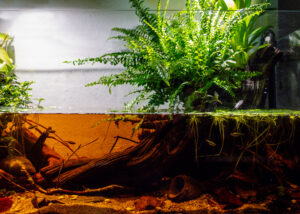
If you want an aquarium that feels like a real slice of nature (not just inspired by it, but built…


Introduction to aquascaping styles Aquascaping is the art of creating underwater landscapes using plants, rocks, wood, and fish. It’s a…

Dutch style aquascaping is one of the oldest and most colorful planted-aquarium styles. Instead of dramatic rocks or twisted driftwood,…

Jungle style aquascaping is vibrant, immersive, and intentionally a little untamed. Instead of strict lines or carefully pruned groupings, this…
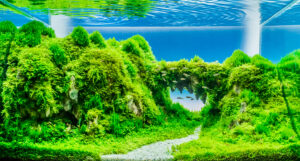
Nature style aquascaping is one of the most beloved approaches in the planted tank world. It’s calm, organic, atmospheric, and…


