Dutch style aquascaping is one of the oldest and most colorful planted-aquarium styles. Instead of dramatic rocks or twisted driftwood, Dutch tanks rely entirely on plants to build structure, depth, and contrast. The result is a vibrant underwater garden! Organized, bold, and always full of life.
If you enjoy strong plant colors, clean lines, and classic underwater horticulture, the Dutch style is a perfect match.

What makes the Dutch style unique
The Dutch style is built on plants: every inch of the layout is shaped by them. A few defining principles set the style apart:
No visible hardscape
Traditional Dutch layouts avoid rocks and wood completely. Plants provide all structure. This has been part of the style since 1930s aquarist societies formalized early Dutch competitions.
Bold color and texture contrast
Lime greens, deep reds, fine leaves, broad leaves. Contrast is key here.
Plant “streets”
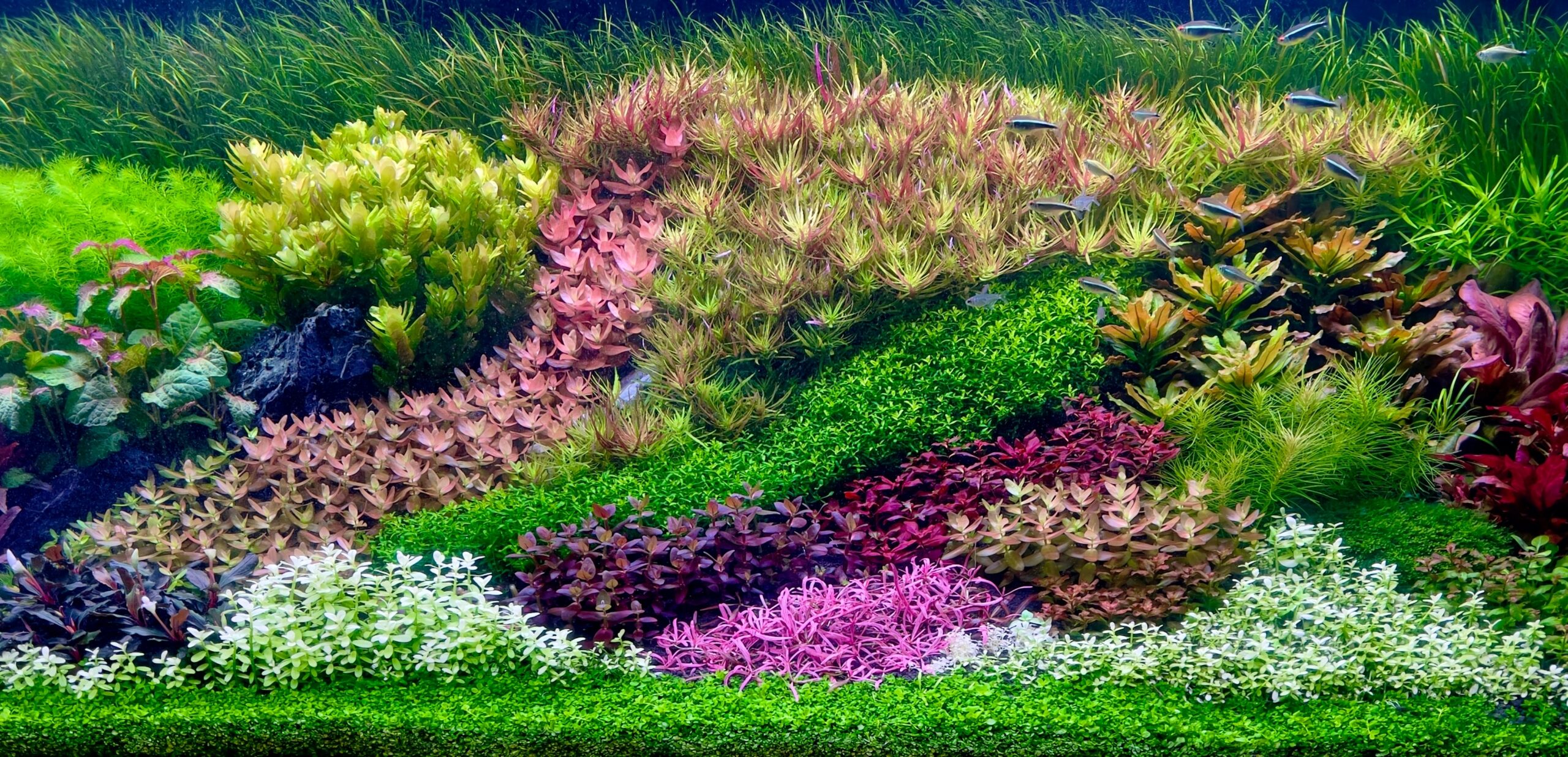
Rows of the same plant narrow toward the back, creating forced perspective and depth.
Terracing and height transitions
Plants rise smoothly from foreground to background so the layout never looks flat.
Organized grouping
Species are arranged in neat, well-defined blocks. Too many different plants scattered around quickly becomes chaotic.
Even though Dutch tanks look lush and full, their structure is highly disciplined beneath the surface.

A brief history
The Dutch style originated in the Netherlands in the 1930s. Local aquarium societies held competitions where tanks were judged on plant health, contrast, composition, and organization. This was long before modern CO₂ injection and high-end lighting existed. Success depended on good plant choice, patience, and careful pruning.
Today, technology has improved, but the philosophy hasn’t changed: plants first, design second, hardscape never.
Planning your Dutch aquascape
Strong Dutch layouts start with planning. Sketching your idea or arranging plant groups on paper helps keep things structured.
Choose a tank shape
Long, rectangular tanks work best because they create room for plant streets and gentle height transitions.
Select the right plants
Dutch aquascapes rely heavily on stems and bold foliage. Good categories include:
- fast-growing stem plants (Rotala, Ludwigia, Limnophila)
- midground foliage plants (Cryptocoryne, bushy stems)
- tall background stems (Hygrophila, Vallisneria)
- occasional red accents for contrast
Avoid overcrowding the species list, too many plants in a small space look messy and unfocused.
Plan for color and texture contrast
Pair opposites for maximum impact:
- red beside green
- fine leaves beside broad leaves
- slow growers beside fast growers
This contrast is what gives Dutch tanks their classic “garden-like” feel.

A Dutch-inspired layout showcasing strong color contrast and structured plant groupings: red and green stems arranged in clean blocks for a classic garden-like look
Substrate, lighting, and CO₂
Dutch tanks depend on strong plant growth, so stable fundamentals matter.
Substrate
Most Dutch layouts use nutrient-rich aquarium soil, which gives more consistent growth than plain gravel. If you use inert gravel, expect to rely on root tabs.
Lighting
Stem plants typically require medium to high intensity:
- 20–40+ lumens per liter
- 5500–6500 K for natural colors
- 6 hours of light at the start, then 8 hours once stable
CO₂ injection
Because Dutch scapes rely on demanding plants, CO₂ is strongly recommended:
- 15–30 mg/L
- Turn on 1 hour before lights
- Keep a gentle surface ripple for oxygen stability

Fertilization and nutrients
Dense plant growth requires steady fertilization.
Plants need:
- macronutrients: nitrogen, phosphorus, potassium
- micronutrients: iron, manganese, trace elements
Both lean dosing (ADA-style) and rich dosing (EI) work, what matters is consistency. Poor plant health and nutrient deficiencies are far more likely to cause algae than high nutrients.
Water parameters and filtration
Water chemistry
Most Dutch-style tanks thrive at:
- pH 6.5–7.5
- KH 2–8 dKH
- GH 4–8 dGH
- temperature 22–26°C
Consistency is more important than perfectly matching numbers.
Filtration and flow
Good filtration ensures clean water and even nutrient/CO₂ distribution. Strong but gentle flow helps avoid dead spots where algae can take hold. Aim for 5–10× turnover per hour.

How to set up a Dutch scape
Here’s a simple, reliable setup plan:
- Add substrate and slope it upward slightly toward the back.
- Plant heavily from day one, especially with fast-growing stems.
- Start with a 6-hour photoperiod to prevent early algae.
- Use moderate CO₂ immediately.
- Perform frequent water changes (25–50% several times weekly) during the first month.
- Add Amano shrimp early, they are extremely effective during startup.
- After a few weeks, increase lighting to 8 hours and begin a regular fertilizer routine.
- Add fish gradually once ammonia and nitrite stay at zero.
Maintenance: Keeping your Dutch tank tidy
Strong plant structure requires regular care, but the results are worth it.
Weekly water changes
Most Dutch tanks benefit from 25–50% changes weekly to reset nutrients and reduce algae risk.
Pruning and replanting
Stem plants need trimming to stay neat and bushy. Removing dying leaves prevents algae, since decaying plant matter often triggers growth.
Algae prevention
Healthy plants are your strongest defense. Research shows algae appears most when plants are stressed, usually from low CO₂ or nutrient deficiencies, not excess. Keep CO₂ steady, avoid sudden changes, and maintain consistent lighting.

Fish and invertebrates for a Dutch scape
Choose peaceful species that complement the structured, garden-like layout:
- small tetras
- rasboras
- small rainbowfish
- peaceful gouramis
For cleanup:
- Amano shrimp (1 per 5–10 L during startup)
- nerite snails
- otocinclus catfish
Amano shrimp are especially effective in new tanks.
Common mistakes to avoid
- Turning lights too high too soon
- Adding fish before cycling is complete
- Using too many plant species
- Relying on fish waste as fertilizer
- Forgetting CO₂ in a high-light setup
- Making sudden changes to light or CO₂ levels
Final thoughts
Dutch style aquascaping is a timeless blend of structure, color, and plant care. With planning and steady maintenance, you can create a vivid underwater garden that feels both classic and elegant. If you enjoy plants, contrast, and organized layout, the Dutch style is one of the most rewarding aquascapes you can build.

Mette Tulin
Mette Tulin is the creator of Aquascapedia, with more than 15 years of hands-on experience in aquascaping, planted aquariums, and freshwater fish, shrimp, crayfish, and snails. She shares practical insights, curated aquatic life profiles, and inspiration to help others build thriving underwater landscapes.
You might also like...
-

Introduction to aquascaping styles Aquascaping is the art of creating underwater landscapes using plants, rocks, wood, and fish. It’s a…
-

Jungle style aquascaping is vibrant, immersive, and intentionally a little untamed. Instead of strict lines or carefully pruned groupings, this…
-
What is Iwagumi? Iwagumi is one of those aquascaping styles you instantly recognize: clean, calm, and seriously beautiful. It might…
-
If you want an aquarium that feels like a real slice of nature (not just inspired by it, but built…
-
Nature style aquascaping is one of the most beloved approaches in the planted tank world. It’s calm, organic, atmospheric, and…


